Comparison
Weighted gauge vs dial gauge pressure canners
Published
Short answer
A weighted gauge (the jiggler or regulator weight) holds pressure by venting steam at a set point, usually 5, 10 or 15 psi, so it never drifts out of calibration. A dial gauge shows the exact pressure, which lets you use the in-between USDA settings at altitude, but it must be tested for accuracy every year. Weighted is simpler; dial is more precise at altitude.
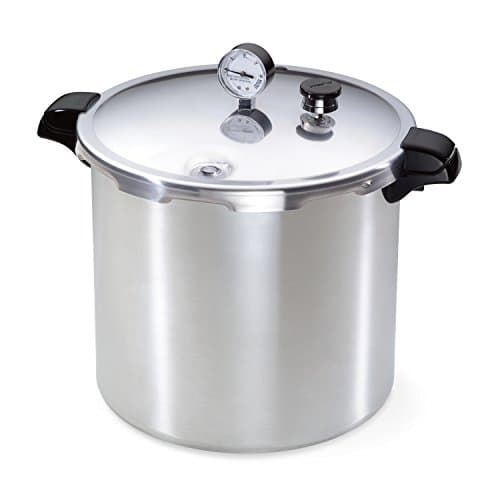
Presto
Presto 01781: 23 qt, 7 quarts, dial gauge
See price on Amazon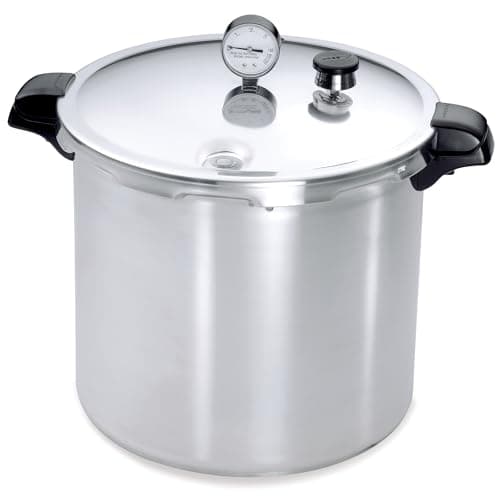
Presto
Presto 01784: 23 qt canner that works on induction
See price on Amazon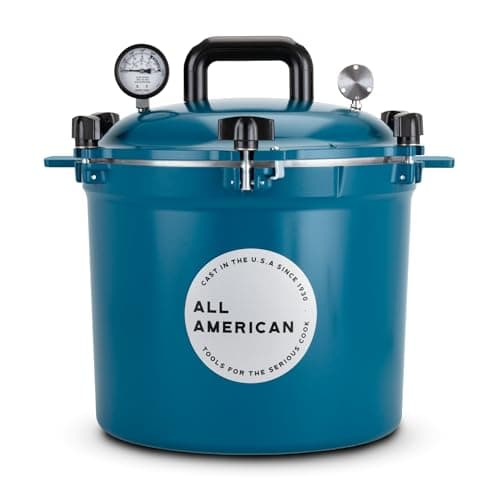
All American
All American 921: 21.5 qt, gasketless metal seal
See price on Amazon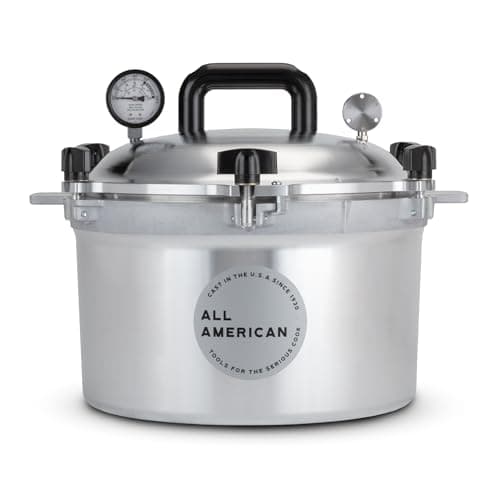
All American
All American 915: 15.5 qt that still fits 7 quarts
See price on Amazon
- Presto 01781: 23 qt, 7 quarts, dial gauge
- Capacity
- 23 qt
- Jar capacity
- 7 quarts, 20 pints, 26 half-pints
- Pressure control
- Dial gauge
- Heat source
- Regular and smooth-top ranges
- Presto 01784: 23 qt canner that works on induction
- Capacity
- 23 qt
- Jar capacity
- 7 quarts, 20 pints, 26 half-pints
- Pressure control
- Pressure gauge, air vent/cover lock
- Heat source
- Induction, gas, electric, smooth-top
- All American 921: 21.5 qt, gasketless metal seal
- Capacity
- 21.5 qt
- Jar capacity
- 7 quarts or 19 pints
- Pressure control
- Steam gauge plus regulator weight
- Heat source
- Gas, electric or flat top
- All American 915: 15.5 qt that still fits 7 quarts
- Capacity
- 15.5 qt
- Jar capacity
- 7 quarts or 10 pints
- Pressure control
- Not stated in listing
- Heat source
- Gas, electric or flat top
| Pick | Capacity | Jar capacity | Pressure control | Heat source | Price | Link |
|---|---|---|---|---|---|---|
| Presto 01781: 23 qt, 7 quarts, dial gauge | 23 qt | 7 quarts, 20 pints, 26 half-pints | Dial gauge | Regular and smooth-top ranges | - | Amazon |
| Presto 01784: 23 qt canner that works on induction | 23 qt | 7 quarts, 20 pints, 26 half-pints | Pressure gauge, air vent/cover lock | Induction, gas, electric, smooth-top | - | Amazon |
| All American 921: 21.5 qt, gasketless metal seal | 21.5 qt | 7 quarts or 19 pints | Steam gauge plus regulator weight | Gas, electric or flat top | - | Amazon |
| All American 915: 15.5 qt that still fits 7 quarts | 15.5 qt | 7 quarts or 10 pints | Not stated in listing | Gas, electric or flat top | - | Amazon |
Facts are taken from each Amazon listing. Prices are checked daily and shown with their date.
Verdict
Below 1,000 feet or if you want zero calibration hassle, favor a canner you can run with a weighted regulator, such as the All American 921. At higher altitude, a dial gauge canner like the Presto 01781 or 01784 lets you use the lower USDA dial settings, as long as you test the gauge every year.
This page is for new canners choosing between a canner with a weighted gauge, a dial gauge, or both. It explains how each one reads and controls pressure, gives the USDA altitude settings that differ by gauge type, covers the yearly dial gauge test, and compares three canners using only their Amazon listing details. Always follow the tested recipe and your canner's manual for venting and water depth.
How a weighted gauge works
A weighted gauge sits on the vent pipe. When pressure inside the canner pushes hard enough to lift it, steam escapes and the weight rocks or jiggles. That release is what holds the pressure at its set point. Some regulators are one piece with three openings for 5, 10 and 15 psi; others use stacked rings. You read it by sound and motion: the manual tells you how many jiggles per minute or how steady a rock means correct pressure.
Because a weight is just a precise mass on a hole, it does not drift with age. The trade off is that it only offers fixed steps. At most altitudes you must use 15 psi with a weighted gauge, even where a dial gauge user could use 12 or 13.
How a dial gauge works
A dial gauge has a needle that reads the pressure inside the canner. You adjust the burner to keep the needle at or slightly above the target. It shows exactly where you are, which helps when you are learning and lets you use the finer USDA settings at altitude. Most dial gauge canners still have a vent and a petcock or counterweight that you use while venting.
The downside is accuracy. Dial gauges can read high or low after drops, age or wear. NCHFP recommends checking a dial gauge for accuracy before each canning season. Many county Cooperative Extension offices test gauges, and some makers offer testing. A gauge that reads low makes you run hot, which is safe but harder on jars; a gauge that reads high makes you under process, which is the dangerous error. See pressure canner gauge testing.
Note.Replace a dial gauge that fails its accuracy test, has a cracked face, or a needle that does not rest at zero. Do not guess a correction.
USDA pressure settings by altitude and gauge type
These are the standard USDA settings for low acid foods in the published process tables. The tested recipe governs if it lists something different, and processing time does not change with altitude, only pressure. Our pressure by altitude tool and altitude chart do the lookup for you.
0 to 1,000
Weighted gauge10 psi
Dial gauge11 psi
1,001 to 2,000
Weighted gauge15 psi
Dial gauge11 psi
2,001 to 4,000
Weighted gauge15 psi
Dial gauge12 psi
4,001 to 6,000
Weighted gauge15 psi
Dial gauge13 psi
6,001 to 8,000
Weighted gauge15 psi
Dial gauge14 psi
8,001 to 10,000
Weighted gauge15 psi
Dial gauge15 psi
| Altitude (ft) | Weighted gauge | Dial gauge |
|---|---|---|
| 0 to 1,000 | 10 psi | 11 psi |
| 1,001 to 2,000 | 15 psi | 11 psi |
| 2,001 to 4,000 | 15 psi | 12 psi |
| 4,001 to 6,000 | 15 psi | 13 psi |
| 6,001 to 8,000 | 15 psi | 14 psi |
| 8,001 to 10,000 | 15 psi | 15 psi |
Note.Above 10,000 feet, contact your county Cooperative Extension office for guidance.
Three canners and their gauges, from the listings
Only listing facts are used here. If a listing does not mention a weighted regulator, the table says so.
Presto 01781
Capacity (listed)23 qt; 7 quarts, 20 pints
Gauge (listed)Dial gauge
Notes from listingListing says the dial registers the full range of processing pressures; weighted regulator not mentioned
Presto 01784
Capacity (listed)23 qt; 7 quarts, 20 pints
Gauge (listed)Pressure gauge
Notes from listingInduction compatible clad base; air vent cover lock; weighted regulator not mentioned
All American 921
Capacity (listed)21.5 qt; about 7 quarts or 19 pints
Gauge (listed)Steam gauge plus regulator weight
Notes from listingMetal to metal seal, no gasket
All American 915
Capacity (listed)15.5 qt; about 7 quarts or 10 pints
Gauge (listed)Not detailed in listing
Notes from listingMetal to metal seal per title
| Model | Capacity (listed) | Gauge (listed) | Notes from listing |
|---|---|---|---|
| Presto 01781 | 23 qt; 7 quarts, 20 pints | Dial gauge | Listing says the dial registers the full range of processing pressures; weighted regulator not mentioned |
| Presto 01784 | 23 qt; 7 quarts, 20 pints | Pressure gauge | Induction compatible clad base; air vent cover lock; weighted regulator not mentioned |
| All American 921 | 21.5 qt; about 7 quarts or 19 pints | Steam gauge plus regulator weight | Metal to metal seal, no gasket |
| All American 915 | 15.5 qt; about 7 quarts or 10 pints | Not detailed in listing | Metal to metal seal per title |
Which gauge fits you
Whatever you buy, vent the canner with steam flowing freely for 10 minutes before bringing it up to pressure, as NCHFP directs, and let it depressurize on its own. Our pressure canner how to walks through each step, and the best pressure canners guide compares more models.
- Under 1,000 feet: a weighted gauge lets you can at 10 psi, so it is the simplest choice.
- Between 2,000 and 8,000 feet: a dial gauge lets you use 12 to 14 psi instead of 15, which is gentler on jars and food texture.
- If you hate annual testing: a weighted gauge never needs calibration, only a clean vent.
- If you are new and want to see what is happening: a dial gauge shows pressure climbing and helps you learn burner control.
- If you want both: the All American 921 listing describes a steam gauge and a regulator weight. Many owners use the weight to control pressure and the dial as a cross check.
Frequently asked questions
Is a weighted gauge more accurate than a dial gauge? A weighted gauge does not drift, so it stays accurate as long as the vent is clean. A dial gauge is precise when tested but can drift, which is why NCHFP recommends testing it every year.
Can I add a weighted regulator to a dial gauge canner? Some makers sell one for their canners. None of the Presto listings here mention it, so check the maker's parts list for your exact model.
Why does my weighted gauge say 15 psi when I live at 2,500 feet? Weighted gauges only offer 5, 10 and 15 psi steps. Above 1,000 feet the USDA tables round up to 15 psi for safety.
What if the dial and the weight disagree? Use the safer reading, then have the dial tested. Never process below the pressure the recipe requires.
What you need for this
- See price on AmazonAmazon
All American 921: 21.5 qt, gasketless metal seal