Comparison
Chamber vacuum sealer vs FoodSaver: liquids, bags, speed and space
Published
Short answer
A FoodSaver is an edge sealer: it pulls air out through the open end of a textured bag, so it is compact and cheaper up front but fights liquids. A chamber sealer puts the whole bag inside a box, so soups and marinades stay put and you can use cheaper smooth pouches. Upgrade if you seal liquids or seal in volume; stay with a FoodSaver if you seal dry cuts a few times a month.
Avid Armor
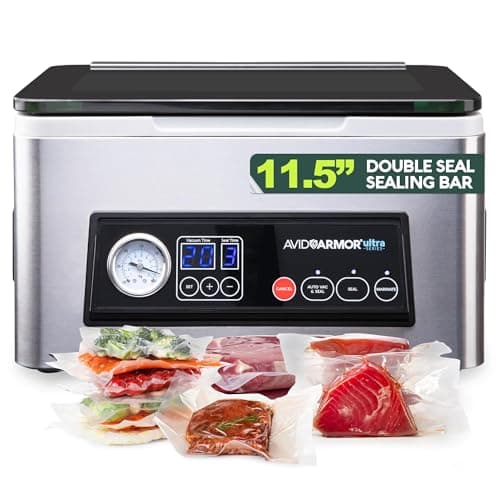
Avid Armor USV20: the chamber alternative
See price on Amazon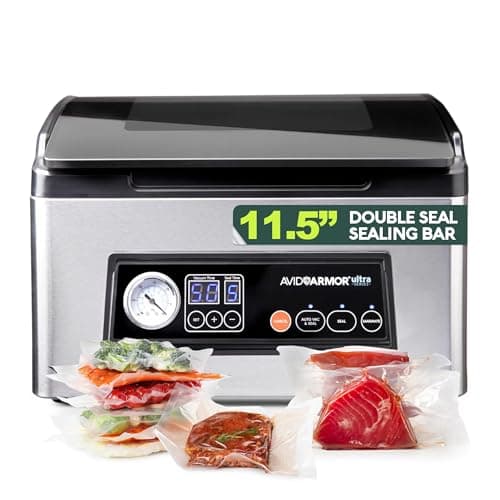
Avid Armor
Avid Armor USV32: chamber sealer pitched at hunters
See price on Amazon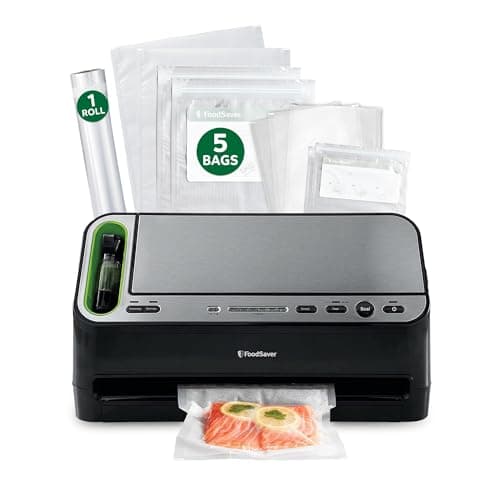
FoodSaver
FoodSaver V4400: auto bag and moisture detection
See price on Amazon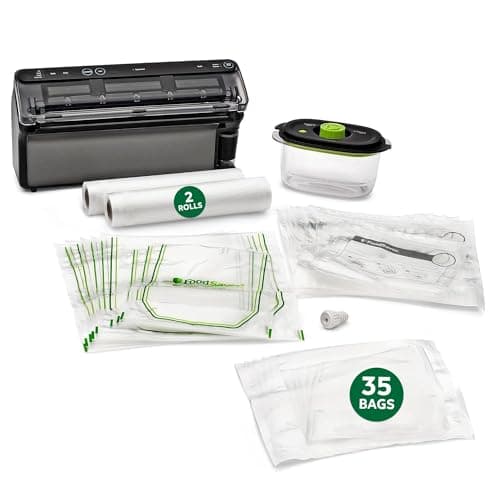
FoodSaver
FoodSaver Elite Liquid+: edge sealer with a Liquid mode
See price on Amazon
- Avid Armor USV20: the chamber alternative
- Seal bar
- 11.5 in, user-replaceable
- Avid Armor USV32: chamber sealer pitched at hunters
- Seal bar
- 11.5 in, dual-wire
- FoodSaver V4400: auto bag and moisture detection
- Seal bar
- -
- FoodSaver Elite Liquid+: edge sealer with a Liquid mode
- Seal bar
- Not stated
| Pick | Seal bar | Price | Link |
|---|---|---|---|
| Avid Armor USV20: the chamber alternative | 11.5 in, user-replaceable | - | Amazon |
| Avid Armor USV32: chamber sealer pitched at hunters | 11.5 in, dual-wire | - | Amazon |
| FoodSaver V4400: auto bag and moisture detection | - | - | Amazon |
| FoodSaver Elite Liquid+: edge sealer with a Liquid mode | Not stated | - | Amazon |
Facts are taken from each Amazon listing. Prices are checked daily and shown with their date.
Verdict
If you seal liquids, marinades or big batches, an Avid Armor USV20 is the lower cost way into chamber sealing, and the USV32 adds a glass lid and marinate mode. If you seal dry cuts a few times a month or need long custom bags, a FoodSaver V4400 or Elite Liquid+ is cheaper and smaller.
This page is for FoodSaver owners who keep hearing that a chamber sealer is the next step and want to know what actually changes. It covers how each machine removes air, why liquids behave differently, what the bags cost you over time, how fast each one works and how much counter space a chamber unit really takes. The spec table uses only what the Amazon listings state for two Avid Armor chamber sealers and two FoodSaver models. Nothing here replaces safe storage: vacuum sealed food still needs the fridge or freezer.
How the two machines remove air
A FoodSaver is an edge (external) sealer. You lay the open end of a bag across the machine, the lid closes on it, and a small pump draws air out through the channels of an embossed or textured bag. When the vacuum level is reached, a heat bar seals the bag. Everything happens at the edge of the bag, so the machine can be small.
A chamber sealer works the other way around. The whole bag sits inside a stainless steel chamber with the open end draped over the seal bar. When the lid closes, the pump removes air from the entire chamber, inside and outside the bag at the same time. Because pressure stays equal on both sides, liquid in the bag is not pulled toward the pump. Then the seal bar closes the bag and air rushes back into the chamber, pressing the bag tight around the food. For a deeper look, see how a chamber vacuum sealer works.
Spec table from the listings
These figures come only from the product listings. Where a listing does not state a number, the table says so rather than guessing.
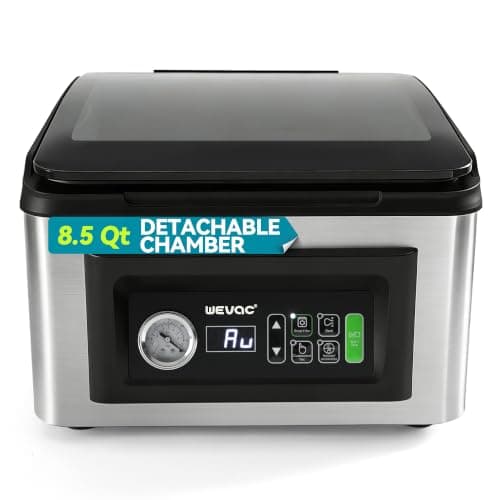
Avid Armor USV20
TypeChamber
Seal bar11.5 in
Liquid handling (per listing)Full chamber pressure, seals soups, stews, marinades
Other listed details4L chamber 12.25 x 8.5 x 3 in; body 14 x 12 x 8.25 in; 17.55 lb; vacuum time 15 to 60 sec; smooth pouches up to 11 x 10 in
Avid Armor USV32
TypeChamber
Seal bar11.5 in dual wire
Liquid handling (per listing)True chamber, seals soups and sauces
Other listed detailsStainless chamber, tempered glass lid, marinate mode, accessory hose port; weight not listed
FoodSaver V4400
TypeEdge
Seal barNot listed
Liquid handling (per listing)Moisture detection and removable drip tray
Other listed detailsAutomatic bag detection, built-in roll storage and cutter, 5 year limited warranty
FoodSaver Elite Liquid+
TypeEdge
Seal barNot listed
Liquid handling (per listing)Liquid mode for liquids above a stated viscosity
Other listed detailsDry, Moist, Liquid, Sous Vide, Marinate and Pulse modes; retractable handheld sealer
| Model | Type | Seal bar | Liquid handling (per listing) | Other listed details |
|---|---|---|---|---|
| Avid Armor USV20 | Chamber | 11.5 in | Full chamber pressure, seals soups, stews, marinades | 4L chamber 12.25 x 8.5 x 3 in; body 14 x 12 x 8.25 in; 17.55 lb; vacuum time 15 to 60 sec; smooth pouches up to 11 x 10 in |
| Avid Armor USV32 | Chamber | 11.5 in dual wire | True chamber, seals soups and sauces | Stainless chamber, tempered glass lid, marinate mode, accessory hose port; weight not listed |
| FoodSaver V4400 | Edge | Not listed | Moisture detection and removable drip tray | Automatic bag detection, built-in roll storage and cutter, 5 year limited warranty |
| FoodSaver Elite Liquid+ | Edge | Not listed | Liquid mode for liquids above a stated viscosity | Dry, Moist, Liquid, Sous Vide, Marinate and Pulse modes; retractable handheld sealer |
Note.The FoodSaver Elite listing qualifies its liquid claim: it applies to liquids with a viscosity of 1.39 mPa·s or higher. Thin broth and water may still be drawn toward the pump.
Liquids: the main reason people upgrade
With an edge sealer, soups, stocks and wet marinades creep toward the open end of the bag as the pump pulls air. Liquid in the seal area can stop the bag from sealing, and liquid that reaches the machine ends up in the drip tray. The usual workarounds are freezing soup flat first, using the moist setting, or leaving extra headspace. The FoodSaver V4400 lists moisture detection and a drip tray, and the Elite Liquid+ adds a liquid mode, which helps but does not change the physics.
In a chamber sealer, liquid stays at the bottom of the bag because the pressure is the same inside and out. That is why both Avid Armor listings lead with soups, sauces and marinades. Keep bags upright, do not overfill, and stop the cycle if hot liquid starts to boil under vacuum. Let soups cool in the fridge before sealing. Our step by step guide to vacuum sealing liquids covers the details, and the best vacuum sealers for liquids guide lists machines that handle them.
Bag cost: smooth pouches vs embossed rolls
Edge sealers need embossed or textured bags so air has a path out. Those bags generally cost more per bag than plain smooth chamber pouches. A chamber sealer does not need the texture, because air leaves the whole chamber, so it can use smooth pouches. The USV20 listing makes exactly this point about affordable smooth pouches cutting long-term supply costs.
The catch is size. A chamber sealer can only seal bags that fit the chamber and seal bar, which is 11.5 inches on both Avid Armor models here, with the USV20 listing smooth pouches up to 11 x 10 inches. A FoodSaver with a roll and cutter can make long bags for a whole loin or a rack of ribs. If you often seal long cuts, check your bag sizes against the chamber first. Our chamber vacuum sealer bags page explains thickness and sizes.
Speed, counter space and upkeep
For one or two bags, an edge sealer is quick: no lid to load, no chamber to pump down. For a batch of twenty portions, a chamber sealer tends to be easier because each cycle is a fixed routine and you are not wrestling with liquid in the seal area. The USV20 lets you set vacuum time from 15 to 60 seconds, so you can shorten cycles for soft foods.
Space is the real cost. The USV20 lists a body of 14 x 12 x 8.25 inches at 17.55 pounds, which is small for a chamber unit but still heavier and taller than a typical FoodSaver. Bigger chamber machines with oil pumps can weigh far more and need a permanent spot. Oil pump models also need oil changes, while both Avid Armor models here are sold as dry pump or maintenance free designs.
- Pick an edge sealer if: you seal mostly dry meat and cheese, you want long custom bags, or counter space is tight.
- Pick a chamber sealer if: you seal soups, stocks, marinades or sous vide portions, you seal in bulk, or bag cost bothers you.
- Keep both if: you already own a FoodSaver. Many people use it for long cuts and the chamber unit for everything wet.
Food safety is the same with either machine
Removing air slows freezer burn and oxidation, which protects quality. It does not make perishable food shelf stable. USDA FSIS guidance is that vacuum packaged perishable food still needs refrigeration or freezing, and low oxygen packaging can let anaerobic bacteria such as Clostridium botulinum grow if food is held warm. Keep sealed raw meat, fish and soups at 40 F or below in the fridge, or freeze at 0 F. See how long vacuum sealed meat lasts and the storage life table for published times.
Note.Never store vacuum sealed garlic in oil, fresh mushrooms, soft cheeses or cooked soups at room temperature. Vacuum sealing is not canning.
Frequently asked questions
Can a chamber sealer use FoodSaver bags? Generally yes, as long as the bag fits the chamber and seal bar, because a chamber sealer does not need a textured bag. You give up the main cost saving, though, since smooth pouches are the cheaper option.
Can a FoodSaver seal soup? It can if you freeze the soup flat first or use a liquid or moist mode, and the FoodSaver Elite Liquid+ listing says it seals liquids above a stated viscosity. Thin liquids are still easier in a chamber sealer.
Is a chamber sealer louder or harder to use? It has more steps per bag because you load the chamber and close the lid, but the cycle itself is automatic. Most people find it simpler once they stop fighting liquid at the seal.
Does a chamber sealer make food last longer than a FoodSaver? Both remove air and both seal. Storage life depends on the food and temperature, so use USDA FSIS freezer and fridge times either way.